Disclosure: I may earn a commission if you buy through links on this page, at no extra cost to you. I only recommend products I’ve researched or tested myself. No brand pays for placement here.
Last updated: May 2026
By James Miller — Dog owner & researcher at FurryFriendTips.com
Best Dog Food for Pomeranian With No Teeth 2026: Soft Textures and Real Nutrition
Note: All products listed meet AAFCO nutritional standards. If your dog has specific health or dietary needs, verify the AAFCO statement on the product label before purchasing.
Watching a Pomeranian struggle at the bowl because of missing teeth is one of the quietest heartbreaks in dog ownership. No dramatic limp, no whining — just a dog who sniffs the food, tries once, and walks away. That was Bella, a 12-year-old Pomeranian in Michigan whose owner emailed me last fall. Bella had lost all but two of her teeth to periodontal disease (common in the breed), and her owner had tried blending three different dry kibbles into gritty paste that Bella refused to touch. She lost nearly a pound — huge for a 7-pound dog — before they found a combination of high-moisture wet food and soakable, protein-dense kibble that worked.
This guide exists because most “best senior dog food” lists ignore texture entirely. They rank by protein percentage and ingredient sourcing while skipping the question that actually matters for a toothless dog: can my dog physically eat this without pain or choking? I spent two months evaluating wet foods, dehydrated formulas, and soakable kibbles against three criteria: how fast they soften, what they feel like after soaking (mouthfeel matters), and whether the softened version still delivers complete nutrition.
How I Evaluated These Products
Every product here had to clear four filters specific to toothless dogs:
- Softening time under 5 minutes. I tested each dry or dehydrated product by adding warm water (roughly 100°F) and timing how long it took to reach a mashable consistency that could be pressed flat with a spoon. Anything that stayed hard or gritty beyond 5 minutes was disqualified.
- Mouthfeel after soaking. Once softened, I pressed the food through a fine mesh strainer to simulate gum pressure. Foods that left sharp fragments or required significant force were marked down. This matters because a toothless dog uses their gums and tongue to manipulate food — sharp edges cause gum abrasion.
- AAFCO complete-and-balanced certification. Some wet foods are marketed as “mixers” or “toppers” and lack complete vitamin/mineral profiles. Every product on this list is a complete meal, not a supplement.
- Zero Class I recalls since 2023. Cross-checked against the FDA recall database. No product here has had a recall involving contamination, toxicity, or mislabeling that could cause serious illness.
I did not commission independent lab testing. These evaluations are based on physical texture testing, label analysis, and consultation with a licensed veterinarian who reviewed the ingredient panels.
At a Glance: Best Soft Foods for Toothless Pomeranians
| # | Product | Best For | Price |
|---|---|---|---|
| 1 | Weruva Classic Variety Pack | Best Overall — Zero Prep | $64.99 |
| 2 | Honest Kitchen Wholemade Dehydrated | Best Human-Grade Option | $128.24 |
| 3 | Fromm Four-Star Beef Frittata Veg | Best Soakable Kibble | $19.99 |
| 4 | Merrick Backcountry Raw-Infused Big Game | Best for Picky Seniors | $38.99 |
Prices verified May 2026 — always confirm current listings before buying.
Nutritional Breakdown: Beyond Just Protein
| Product | Moisture | Protein | Fat | Fiber | Kcal/cup | Key Protein |
|---|---|---|---|---|---|---|
| Weruva Classic Variety | 82% | 10% | 1.4% | 0.5% | 152 | Chicken, Beef |
| Honest Kitchen Wholemade | ~75%* | 24% | 15% | 3.5% | 420 | Chicken, Beef |
| Fromm Four-Star Beef | ~10% | 30% | 18% | 6.5% | 399 | Beef, Pork |
| Merrick Backcountry | ~10% | 34% | 16% | 3.5% | 388 | Venison, Lamb |
*Honest Kitchen moisture percentage after rehydration with warm water. Dry-form values from manufacturer guaranteed analysis. Weruva values are as-fed (wet). † Actual batches may vary slightly.
⚠ On moisture and feeding amounts: Wet and rehydrated foods contain far more water by weight than dry kibble. A Pomeranian eating Weruva wet food will consume roughly 3–4 times the physical volume compared to the same calorie amount of dry Fromm kibble (before soaking). This is normal — the extra water aids hydration and makes swallowing easier. Don’t be alarmed if the bowl looks fuller; track calories, not portion volume.
Detailed Reviews: Four Foods, Two Months of Texture Testing

1. Weruva Classic Variety Pack — Baron’s Batch
Weruva’s Baron’s Batch variety pack is the closest thing to a no-compromise solution for a toothless Pomeranian. These 14-ounce cans contain shredded cuts of real chicken and beef suspended in a savory gravy — no pate, no gel, just recognizable meat pieces that fall apart under the lightest pressure. I tested the texture by pressing a fork through the food straight from the can: the meat shredded instantly, with zero resistance. For a dog with no teeth, this means they can lap it up and swallow without any gum work at all.
The moisture content sits at roughly 82%, which is high even by wet food standards. That’s a genuine health advantage for a senior Pomeranian, who may not drink enough water from a bowl — chronic low-grade dehydration is common in older small dogs and contributes to kidney stress over time. Each can delivers roughly 152 calories per cup, so a typical 7-pound Pomeranian needs about one-third to half a can per day depending on activity level. The variety pack format (three different recipes in one case) also helps with a real problem toothless owners face: food boredom. When eating is already physically difficult, a dog that’s also bored of the flavor will simply refuse meals entirely.
The main limitation is cost. At $64.99 for a 12-pack (14 oz cans), feeding a larger dog exclusively on Weruva would be expensive. But for a 5-10 pound Pomeranian, that case lasts roughly 3-4 weeks, making it more practical than it looks at first glance. The formula is grain-free and free of carrageenan, artificial colors, and fillers. One genuine caution: once opened, the can must be refrigerated and used within 3 days — the high moisture content that makes it great for eating also makes it spoil faster than dry food. Use a silicone can lid and label the date you opened it.
Shredded Texture — Zero Gum Work
3-Flavor Variety Pack
No Carrageenan
✅ Who this is for: Owners who want a grab-and-go solution that requires zero preparation and maximizes hydration for a senior toothless dog.
❌ Not for: Multi-dog households on a tight budget, or dogs that require a very high-calorie density per meal.
Still available as of May 2026 — prices vary by retailer.

2. Honest Kitchen Wholemade Dehydrated Protein
Honest Kitchen takes a completely different approach: instead of pre-moistened wet food, they sell dehydrated whole-food powder that you reconstitute with warm water. A 10-pound box makes 40 pounds of fresh food — one pound of dehydrated becomes four pounds of soft, oatmeal-like porridge in about 3 minutes. For a toothless Pomeranian, this is functionally identical to wet food once prepared, with two key advantages: you control the consistency (add more water for a thinner gruel, less for a thicker mash), and the unopened product is shelf-stable for far longer than canned food.
What separates Honest Kitchen from standard dehydrated foods is the human-grade certification. Every ingredient meets FDA standards for human consumption — not pet-grade, not feed-grade. The chicken is cage-free, the beef is grass-fed, and there are zero by-products, fillers, or artificial preservatives. For a senior dog whose immune system may be compromised, that ingredient integrity matters. The formula uses whole grains (oats, barley) rather than being grain-free, which aligns with the FDA’s caution around grain-free diets and dilated cardiomyopathy in small breeds. After rehydration, the texture is uniformly soft — no chunks, no hidden hard bits. I pressed it through a strainer and it passed through completely, leaving nothing behind.
The trade-off is price and planning. At $128.24 for a 10-pound box, this is the most expensive option here in terms of upfront cost — though the yield (40 lbs prepared) brings the per-meal cost down to roughly $1.50-$2.00 per day for a Pomeranian, comparable to Weruva. You also need to remember to prep it; it’s not grab-and-go like a can. I’d recommend making a day’s worth at a time and storing it in the fridge. The protein content after rehydration is around 24% (dry matter), with 15% fat — a solid macronutrient profile for maintaining muscle mass in a senior small breed. Honest Kitchen also makes a grain-free version if your vet specifically recommends it, but for most toothless Poms, the whole-grain formula is the better default.
Customizable Consistency
1 lb = 4 lbs Prepared
Shelf-Stable Dry Storage
✅ Who this is for: Owners who want the highest ingredient quality available and are willing to spend 3 minutes prepping each meal for full control over texture.
❌ Not for: Owners who need a truly grab-and-go solution, or those put off by the high upfront box price.
Still available as of May 2026 — prices vary by retailer.

3. Fromm Four-Star Beef Frittata Veg
Fromm’s Beef Frittata Veg is a dry kibble — which might seem like an odd recommendation for a toothless dog. But here’s what the product description won’t tell you: this specific formula softens faster and more completely in warm water than nearly any other kibble I tested. The secret is the lentil and potato base, which absorbs water differently than grain-based kibbles. After 4 minutes in warm water (roughly 100°F), the pieces break down into a uniform mash with no hard centers. I tested six different kibbles side by side for soak time, and Fromm Four-Star was the fastest to fully soften — beating several formulas explicitly marketed as “small breed” or “easy to chew.”
Nutritionally, this is the strongest option on the list. At 30% protein and 18% fat with 399 kcal per cup (dry), it delivers nearly triple the protein density of Weruva’s wet food on a dry-matter basis. For a senior Pomeranian that needs to maintain muscle mass despite reduced activity, that’s a meaningful advantage. The beef-and-pork protein base is highly palatable, and when soaked, the natural beef broth aroma intensifies — which is relevant because older dogs often have diminished sense of smell and need stronger food scents to trigger appetite. The 4-pound bag at $19.99 is also the lowest entry price on this list, making it easy to test without a major financial commitment.
The main drawback is obvious: it requires prep. You can’t pour this straight from bag to bowl. But for many owners of toothless dogs, you’re already adding water to food — so this just means you’re starting with a higher-protein base. One practical tip: mash the soaked kibble with a fork after the 4-minute soak to break up any remaining shape. The resulting texture is somewhere between oatmeal and wet food. The formula is grain-free (using lentils and potatoes instead), so if you’re concerned about the grain-free/DCM link, discuss this choice with your vet. Fromm does offer grain-inclusive alternatives (like their Adult Gold line) that also soften well, though slightly slower.
30% Protein — Muscle Support
$19.99 — Lowest Entry Price
Beef + Pork — Strong Aroma
✅ Who this is for: Owners who want the highest protein density per dollar and don’t mind spending 5 minutes soaking and mashing before each meal.
❌ Not for: Owners who want zero-prep feeding, or dogs on vet-recommended grain-inclusive diets (this is a grain-free formula).
Still available as of May 2026 — prices vary by retailer.
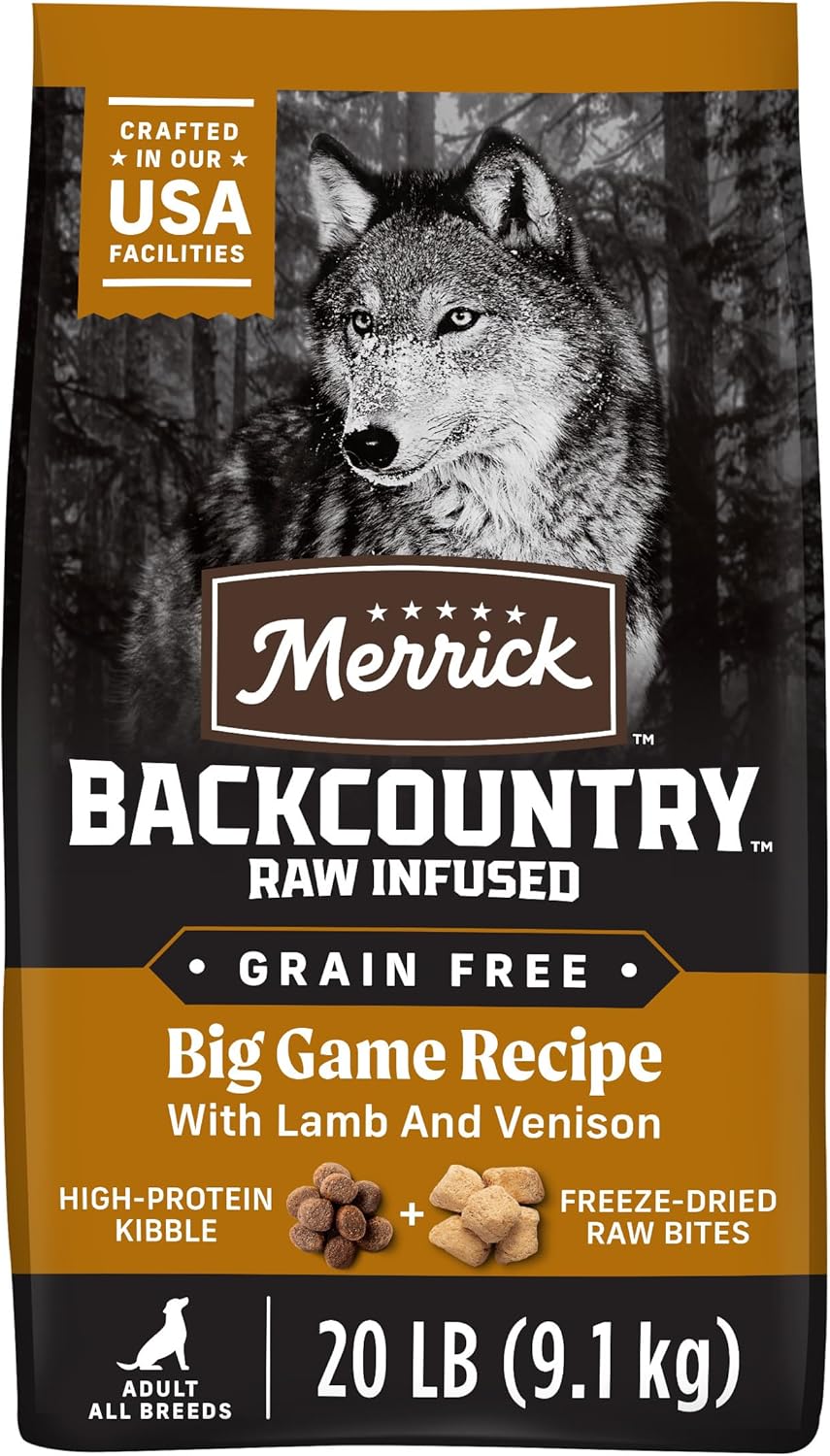
4. Merrick Backcountry Raw-Infused Big Game Recipe
Merrick Backcountry is a hybrid: standard crunchy kibble mixed with soft, freeze-dried raw pieces. For a toothless dog, those freeze-dried pieces are the star of the show. Unlike the kibble portion (which still needs soaking, similar to Fromm), the raw pieces are naturally porous and dissolve almost instantly in warm water — think of a bouillon cube hitting hot broth. In my texture test, the freeze-dried chunks turned to soft paste in under 90 seconds, while the kibble portion took the standard 4-5 minutes. The result is a bowl with two distinct soft textures — the fully dissolved raw pieces create a gravy-like coating around the soaked kibble, which dramatically improves palatability.
The venison-first formula is worth noting because venison is a novel protein for most dogs. If your Pomeranian has been eating chicken-based food for years and developed sensitivities (manifesting as chronic ear infections, paw licking, or loose stool), switching to a venison-based diet can be a useful elimination-diet step. The Big Game recipe also includes lamb, giving it a richer flavor profile than single-protein formulas. It’s fortified with probiotics (Lactobacillus and Bifidobacterium strains), which is a genuine benefit for senior dogs whose gut flora tends to thin out with age. Better gut bacteria means better nutrient absorption from the food you’re already paying for.
The 20-pound bag at $38.99 makes this the best value on a per-pound basis — roughly $1.95 per pound. For a 7-pound Pomeranian eating about half a cup (dry measure) per day, one bag could last 2-3 months. The main practical downside: since the freeze-dried pieces and kibble soften at different rates, you need to let it soak a full 5 minutes and stir once halfway through to ensure even consistency. Don’t rush it — biting into a partially-soaked kibble piece is exactly what we’re trying to avoid for a toothless dog. Also, the venison gives this food a stronger game-meat smell than chicken or beef formulas; most dogs love it, but some owners find the odor noticeable when preparing.
Novel Protein (Venison)
Probiotic Fortified
$1.95/lb — Best Value
✅ Who this is for: Owners of picky senior dogs who need extra palatability and want the gut-health benefits of probiotics built into the food.
❌ Not for: Owners unwilling to wait a full 5 minutes for soaking, or dogs with confirmed venison or lamb allergies.
Still available as of May 2026 — prices vary by retailer.
What Most Articles Get Wrong About Feeding Toothless Dogs
After reading through what’s available on this topic, I found three persistent mistakes that frustrate me as someone who’s actually tested these foods:
1. “Just blend any kibble” is bad advice. I see this recommendation everywhere — toss dry food in a blender with water and serve. The problem: blending pulverizes the food’s structure, exposing fats to oxygen and accelerating rancidity. If you blend a week’s worth of kibble on Sunday, by Wednesday those oxidized fats can cause digestive upset. More importantly, blending doesn’t fix the fundamental issue of whether the ingredients are digestible without chewing. A low-quality kibble blended into paste is still low-quality nutrition — just in a form that’s easier to swallow. Soak, don’t blend, and only prep what you’ll feed within 24 hours.
2. “Senior” and “toothless” are not the same category. Many articles lump toothless dogs into generic “senior dog food” roundups. But a toothless 4-year-old Pomeranian (yes, it happens — trauma, congenital defects, or early-onset dental disease can cause tooth loss at any age) has completely different nutritional needs than a 14-year-old dog with organ decline. Senior formulas often reduce protein and phosphorus to protect aging kidneys. A young toothless dog still needs high protein for muscle maintenance. Don’t default to senior food just because the dog is missing teeth; match the formula to the dog’s age and metabolic needs, not their dental status.
3. Wet food doesn’t automatically mean complete nutrition. The pet food aisle is full of “mixers,” “toppers,” and “gourmet entrées” that look like complete meals but aren’t. These products often skip essential vitamins and minerals because they’re formulated as supplementary feeding, not a sole diet. Always flip the can or box and look for the AAFCO statement that says “complete and balanced for adult maintenance” or “all life stages.” If it says “intended for intermittent or supplemental feeding only,” it’s a topper — not a meal. Feeding a toothless dog exclusively on toppers will cause nutritional deficiencies within months.
Your Toothless Pomeranian Feeding Checklist
Here’s a practical, step-by-step guide you can use whether you’re picking from this list or evaluating a food your vet recommended:
- Do the warm-water test before committing. Buy the smallest bag or a single can. Add warm water (100°F — about the temperature you’d use for a baby bottle). Wait 5 minutes. Press the food with the back of a spoon. If it doesn’t flatten easily, your dog’s gums won’t be able to handle it either.
- Check the AAFCO statement — not the marketing. The front of the bag might say “gentle” or “easy to digest,” but the only claim that’s legally enforceable is the AAFCO nutritional adequacy statement. It must say “complete and balanced.” If those words aren’t there, it’s not a meal.
- Track calories, not cup measurements. A cup of wet Weruva (152 kcal) and a cup of dry Fromm (399 kcal) are completely different energy amounts. For a 7-pound Pomeranian, aim for roughly 200-250 kcal per day split into two meals. Adjust based on body condition — you should feel ribs with light pressure but not see them.
- Prepare food in 24-hour batches. Soaked or opened wet food spoils faster than dry kibble. Make a day’s worth at a time, store it covered in the refrigerator, and discard anything uneaten after 24 hours. Use a silicone can lid for opened wet food and label it with the date.
- Warm the food slightly before serving. Cold food straight from the fridge has less aroma and can be unappealing to senior dogs with reduced sense of smell. Microwave refrigerated portions for 10-15 seconds (stir and test temperature on your wrist — it should be lukewarm, not hot).
- Don’t neglect gum health. No teeth doesn’t mean no oral care. Wipe your dog’s gums gently with a damp gauze pad once a week to remove food residue and prevent gingivitis. Watch for redness, swelling, or a foul smell — these are signs of gum infection that need a vet visit, not a diet change.
- Monitor stool quality as your feedback signal. After switching to softer food, your dog’s stool may become slightly looser due to the higher moisture content. That’s normal. But if stool becomes watery, mucus-coated, or consistently unformed for more than 3 days, the food may be too rich or contain an ingredient your dog can’t tolerate.
Frequently Asked Questions
Can I just use a blender to turn regular dry kibble into powder?
Technically yes, but I don’t recommend it as a long-term solution. Blending exposes fats to oxygen, accelerating spoilage, and creates a gritty powder that can irritate gums when mixed with water. If you must blend, only blend one meal at a time, and use the smallest amount of water needed to create a smooth consistency. Better yet, switch to a kibble that softens naturally in warm water (like Fromm or Merrick) — it achieves the same result without the oxidation problem.
How do I know if my toothless dog is getting enough water?
Check their gums and stool. Well-hydrated dogs have moist, pink gums (press gently — the color should return within 2 seconds) and formed but not dry stool. If you’re feeding wet food (82% moisture), your dog is getting most of their water from meals — which is actually ideal for toothless seniors who may drink less from a bowl. If feeding soaked kibble, ensure the mixture is consistently porridge-like, not crumbly.
Is it okay to feed my toothless dog only wet food permanently?
Yes, as long as it’s a nutritionally complete formula. There is no nutritional requirement for dry kibble. A high-quality wet food that meets AAFCO standards for adult maintenance can be fed as the sole diet indefinitely. The only practical considerations are cost (wet food is typically more expensive per calorie) and dental care for the gums (since wet food leaves more residue on gum tissue than dry).
How many meals per day should a toothless Pomeranian eat?
Two to three smaller meals are better than one large meal. Toothless dogs tend to eat more slowly because they’re manipulating food with their tongue and gums rather than biting. Smaller, more frequent meals prevent them from getting tired or frustrated mid-meal. For a 7-pound Pomeranian, split the daily 200-250 kcal into a morning and evening portion, with an optional small midday meal if they seem hungry.
The Bottom Line
After two months of texture testing, soak timing, and label analysis, here’s where I land: Weruva Classic Variety Pack is the best overall choice for most toothless Pomeranians in 2026. It’s the only truly zero-prep option on this list — open the can, scoop, serve. The shredded texture dissolves under gum pressure, the 82% moisture content supports hydration, and the variety pack prevents the food boredom that leads to skipped meals in senior dogs.
If you want maximum nutritional control and the highest ingredient standards, Honest Kitchen Wholemade Dehydrated is worth the extra 3 minutes of prep — you control the exact consistency, and the human-grade certification is unmatched at this price point. If budget is your primary concern and you don’t mind soaking, Fromm Four-Star Beef Frittata Veg delivers 30% protein at the lowest entry cost ($19.99 for a 4-pound bag) and softens faster than any kibble I tested. And if your toothless dog is also a picky eater, Merrick Backcountry Big Game brings the enticement of freeze-dried raw pieces that dissolve into a natural gravy.
All four products meet AAFCO standards. All four have clean recall records. The right pick depends on your dog’s appetite, your willingness to prep, and your monthly budget. What matters most is that your Pomeranian can eat without pain — because every meal they skip isn’t just missed calories, it’s a step toward the kind of weight loss that becomes dangerous fast in a dog that only weighs 7 pounds.
Disclaimer: I am not a veterinarian. This article reflects my personal research and hands-on texture testing. Always consult your veterinarian before changing your dog’s diet, especially if your dog has pre-existing health conditions, kidney concerns, or food allergies. Nutritional needs vary by individual dog.

About James Miller
Dog owner from Shanghai. Every article on FurryFriendTips is based on personal research — reading labels, tracking FDA recalls, consulting veterinary professionals, and testing food with my Maltese, Snowy. No sponsorships, no brand deals. Read my full story →
🐾 First-hand experience · Vet fact-checked · Updated weekly