Disclosure: FurryFriendTips may earn a commission if you purchase through links on this page, at no extra cost to you. All evaluations are based on nutritional data and independent analysis — not brand partnerships.
What This Guide Covers
A complete breakdown of high-protein dog food nutrition science, AAFCO standards, protein requirements by breed and activity level, and 8 detailed product reviews ranked by protein density, ingredient quality, and real-world value. Includes cost-per-day calculations for a 50lb dog and a downloadable comparison chart.
What High Protein Actually Means for Dogs in 2026
The word “high protein” is used so loosely in pet food marketing that it has nearly lost all meaning. In 2026, a brand can slap “high protein” on a 22% crude protein formula and technically not be lying — but that doesn’t make it high-performance nutrition. Understanding what separates a genuinely protein-dense formula from a mediocre one requires looking past the marketing and into the bag.
Crude protein percentage is the measure used on every pet food label. It represents the nitrogen content of the food, which is used to estimate total protein. What it does not tell you is the digestibility coefficient of that protein — how much of it your dog actually absorbs — or the amino acid profile, which determines whether the protein supports all biological functions or just basic survival.
For working breeds, sporting dogs, and active companions, these distinctions matter significantly. A 30% crude protein formula made primarily of plant-based proteins will deliver less usable muscle-building nutrition than a 26% formula anchored by chicken meal, fish meal, and organ meats. The first number means very little without understanding the source.
AAFCO Standards: What Minimum Protein Levels Actually Mean
The Association of American Feed Control Officials (AAFCO) establishes baseline nutritional standards for pet food sold in the United States. For adult maintenance, the minimum crude protein requirement is 18% for dry food. For growth and reproduction (puppies, pregnant, or lactating dogs), the minimum rises to 22%.
What the AAFCO minimums do not specify is quality. A food can meet the 18% minimum and still rely on low-digestibility protein sources that produce excessive fecal matter, poor coat quality, and suboptimal muscle maintenance. This is why “meets AAFCO standards” on a label tells you only that a food is legally complete — not that it is optimally formulated.
For a working dog or any dog in consistent physical training, most veterinary nutritionists recommend targeting 25% to 38% crude protein from named animal sources, with fat content above 15% for sustained energy. Formulas that exceed these ranges without corresponding increases in fat often lead to excessive nitrogen waste and increased thirst — a signal that protein is being used inefficiently as an energy source rather than as a building block.
AAFCO Protein Quick Reference: Adult maintenance minimum: 18% | Growth/reproduction minimum: 22% | Performance/sporting dogs: 25-38% | Raw or fresh-food diets can exceed 40%, but dry kibble above 42% requires careful fat ratio monitoring
How Much Protein Does Your Dog Actually Need?
Protein requirements are not one-size-fits-all. They vary based on age, activity level, breed size, metabolic rate, and whether a dog is intact or neutered. Using a 50lb adult dog as the reference point:
- Sedentary adult (indoor companion): 25-30g per day — approximately 22-26% crude protein in kibble
- Moderately active (daily walks, play): 40-50g per day — approximately 26-30% crude protein
- Highly active or working (agility, hunting, herding): 60-80g per day — approximately 30-38% crude protein
- Puppies (all breeds under 12 months): 28-35% crude protein with controlled calcium-to-phosphorus ratio
- Pregnant or lactating females: 28-32% crude protein, with fat above 20% for energy density
Large and giant breed puppies present a specific challenge: they need high protein for muscle development, but excessive protein combined with rapid growth can stress developing joints and bones. For breeds like Great Danes, Mastiffs, and German Shepherds, working with a veterinarian to select a formula specifically balanced for large breed growth is critical — do not simply feed an adult high-protein formula to a growing puppy of a large breed.
The Protein Source Hierarchy: What Goes Into the Bowl Matters
Not all protein is equal. The source determines digestibility, amino acid completeness, and allergen profile. Here is how the most common sources in commercial dog food stack up:
- Whole muscle meats (chicken, beef, turkey): ~70-75% digestibility. Excellent amino acid profile when used as a primary ingredient. Quality varies by processing conditions and freshness at time of cooking.
- Meat meals (chicken meal, fish meal, lamb meal): ~75-80% digestibility. Concentrated protein source with lower moisture content than whole meat. Quality depends heavily on the named species — “chicken meal” is superior to “poultry meal.”
- Organ meats (liver, kidney, heart): ~80-85% digestibility. Exceptional amino acid density and micronutrient richness. Should comprise no more than 10-15% of total ingredient weight in a complete formula.
- Plant proteins (pea protein, soy, corn gluten): ~60-70% digestibility. Lower biological value than animal proteins. Often used as supplementary protein to reduce cost. Plant protein inclusion above 15-20% of total protein in grain-free formulas has been flagged in the DCM discussion.
- Eggs: ~90-95% digestibility. Complete amino acid profile. Used sparingly in kibble but highly effective as a supplementary protein source.
Reading the ingredient list — not just the guaranteed analysis — is the only way to understand whether a food’s protein comes from quality animal sources or is padded with plant proteins to hit a marketing percentage. If the first three ingredients are not named animal proteins, the formula is primarily plant-fueled regardless of what the crude protein number suggests.
High Protein Dog Food Comparison Table
| Product | Protein (Crude) | Fat | Cal/Cup | Best For | Price (50lb/month) |
|---|---|---|---|---|---|
| Bully Max 30/20 | 30% | 20% | 535 | Working dogs, muscle gain | ~$85 |
| VICTOR Hi-Pro Plus | 30% | 20% | ~488 | Sporting, active breeds | ~$68 |
| Orijen Amazing Grains | 38% | 18% | ~449 | Premium, all-performance | ~$135 |
| Eukanuba Premium Performance | 26% | 16% | ~460 | Canine athletes, active | ~$105 |
| Annamaet Original Ultra | 32% | 22% | ~500 | Performance, pregnancy | ~$140 |
| Instinct Raw Boost | 37% | 17% | ~460 | Active dogs, raw curious | ~$115 |
| Merrick Backcountry Venison | 38% | 15% | ~380 | Grain-free, allergy dogs | ~$75 |
| Farmina N&D Lamb | 26% | 15% | ~350 | Grain-free, sensitive digestion | ~$120 |
*Cost estimates for a 50lb dog at moderate activity level. Prices vary — always verify current listings. Calories per cup vary by batch and flavor; check the specific bag label.
8 Best High Protein Dog Foods in 2026
Editor’s Pick: Bully Max 30/20 — Best Overall High-Protein Formula

Bully Max 30/20 High Performance Dog Food
Rating: 4.6/5 | 535 cal/cup | $60.85 / 15lb bag
The only 5-star rated performance formula across major independent review platforms. Delivers 30% protein and 20% fat with 535 calories per cup — among the highest caloric density of any mass-market kibble. Made in the USA, zero recalls, no corn/wheat/soy/by-products or artificial additives. Suitable for all breeds and life stages including puppies and seniors.
Chicken Meal, White Fish Meal
~33%
~22%
535 cal/cup
Yes
None (zero)
What sets it apart: At 535 calories per cup, Bully Max allows owners to feed significantly smaller portions while delivering more usable energy than most competitors. For owners of large breed working dogs — German Shepherds, Belgian Malinois, Dutch Shepherds, Labrador Retrievers — this caloric density matters because it reduces feeding volume, which in turn reduces gastric volume and associated digestive stress during intense training sessions.
The trade-off: Bully Max’s intensity is not appropriate for inactive or senior dogs who do not burn the caloric surplus. Feeding this formula to a couch potato dog will result in weight gain. For senior dogs or dogs with reduced activity, halve the portion and monitor weight closely, or select a less calorically dense formula.
535 cal/cup
Made in USA
High Caloric Density
$60.85 / 15lb bag | ~$85/month for a 50lb moderately active dog
2. VICTOR Hi-Pro Plus — Best Value High Protein

VICTOR Hi-Pro Plus Super Premium Dry Dog Food
Rating: 4.5/5 | ~$65.44 / 40lb bag | Amazon’s Choice
A family-owned Texas brand that has been producing super-premium kibble since the 1970s. Hi-Pro Plus delivers 30% protein from a multi-meat blend (beef, chicken, pork, and fish meals) with the proprietary VPRO supplement blend for enhanced nutrient absorption. A 40lb bag under $70 makes this the most cost-effective high-protein option in this guide for multi-dog households.
Beef, Chicken, Pork, Fish Meals
~33%
~22%
All Life Stages*
Yes (gluten-free)
Minimal (none in 10+ years)
What sets it apart: VICTOR Hi-Pro Plus has built its reputation on consistent formulation, Texas-based manufacturing, and a multi-protein approach that delivers a more complete amino acid profile than single-protein formulas. The VPRO blend — a proprietary mix of vitamins, minerals, and digestive support — addresses a common gap in competing formulas at similar price points. For sporting dog owners and breeders running multiple dogs, the cost-to-protein ratio is unmatched.
The caveat: VICTOR Hi-Pro Plus carries an AAFCO approval for all life stages, but the fine print excludes “growth of large size dogs (70 lb. or more as an adult).” If you have a Great Dane, Mastiff, or Saint Bernard puppy, look elsewhere for large-breed-specific growth formulas. For all other breeds and sizes, including working puppies under 70lbs as adults, this formula is an excellent choice.
Amazon’s Choice
Multi-Protein
Best Cost/Protein Ratio
$65.44 / 40lb bag | ~$68/month for a 50lb moderately active dog
3. Orijen Amazing Grains — Best Premium High Protein
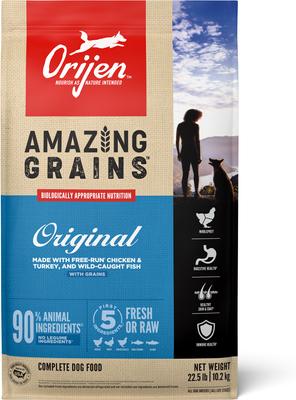
Orijen Amazing Grains
Rating: 5.0/5 | $116.48 / 26lb bag | Award-Winning Formula
Champion Petfoods’ Orijen line represents the apex of mass-market kibble formulation. The Amazing Grains variant delivers 85% quality animal ingredients with WholePrey ratios — mirroring the muscle-organ-bone proportions of a wild animal’s diet. Made entirely in Orijen’s own US-based kitchens with zero outsourcing. No corn, wheat, soy, artificial flavors, or preservatives.
Chicken, Turkey, Eggs, Wild Fish, Liver
~42%
85% (vs. 15% in typical kibble)
In-house only (zero outsourcing)
No (whole grains included)
None added
What sets it apart: Orijen Amazing Grains is the most scientifically advanced mass-market formula in this guide. The 85% animal ingredient ratio is not matched by any competitor at any price point except raw fresh food. The inclusion of whole grains — steel-cut oats, millet, and sorghum — rather than grain-free alternatives addresses the DCM debate directly: Orijen uses legumes only minimally and pairs them with whole grains for a balanced carbohydrate profile that most veterinary cardiologists consider lower-risk than grain-free legume-heavy formulas.
The trade-off: Orijen is expensive — the highest per-bag cost in this guide. For owners running multiple large dogs, the monthly cost is substantial. Additionally, the first 5 ingredients include fresh whole meats, which means the actual dry-matter protein percentage is slightly lower than the as-fed label suggests due to moisture content. This is normal and expected, but worth understanding when comparing dry-matter percentages across brands.
WholePrey Ratios
No Synthetic Supplements
Premium Price Point
$116.48 / 26lb bag | ~$135/month for a 50lb moderately active dog
4. Eukanuba Premium Performance 26/16 — Best for Canine Athletes

Eukanuba Premium Performance Exercise Formula
Rating: 4.8/5 | $75.99 / 28lb bag | Amazon’s Choice + Best Seller
Backed by 50+ years of scientific research from the Mars petcare conglomerate, Eukanuba Premium Performance is the formula of choice for serious canine athletes — competition agility dogs, search and rescue teams, and high-drive working breeds. Contains glucosamine, chondroitin sulfate, EPA, and DHA for joint support and post-exercise recovery. Clinically proven antioxidants support immune function under physical stress.
What sets it apart: Where most brands market “high protein” as a lifestyle claim, Eukanuba treats it as a sport science discipline. The 26/16 ratio is not the highest protein in this guide, but it is the most precisely calibrated for sustained athletic output. The inclusion of DHA for cognitive function during extended training sessions, combined with joint-supporting glucosamine and EPA, reflects a performance nutrition philosophy that most competing brands do not match at any price.
The trade-off: At 26% protein, this is not the highest-protein formula in the guide. For truly high-intensity activities (weight pulling, extended tracking, bite work), the protein level may need supplementation or a formula swap. For most working dog applications — agility, obedience, rally, hunting — this is dialed in correctly.
Joint Support
DHA for Brain
Clinically Proven
$75.99 / 28lb bag | ~$105/month for a 50lb active dog
5. Annamaet Original Ultra — Best for Demanding Life Stages

Annamaet Original Ultra Formula
Rating: 4.4/5 | $134.99 / 40lb bag | Amazon’s Choice
A family-owned Pennsylvania brand with over 30 years of formulation experience. Annamaet Ultra is designed specifically for the most metabolically demanding conditions: performance dogs, working puppies, and lactating females. Uses proteinated (chelated) minerals for enhanced mineral absorption, L-Carnitine for fat utilization and lean body mass, and antibiotic-free chicken as the primary protein source. Corn, wheat, and soy free. Produced in small batches with artisanal quality control.
What sets it apart: The use of proteinated minerals is Annamaet’s most technically significant differentiator. Standard mineral supplements in pet food are often poorly absorbed — the body must work harder to utilize them. Chelated (proteinated) minerals are bound to amino acids, which allows the intestinal wall to absorb them more efficiently. For dogs under extreme physical stress — lactating females, working puppies, competition dogs — this enhanced bioavailability can make a measurable difference in recovery time and coat quality.
The trade-off: At $134.99 for 40lbs, Annamaet Ultra is priced for serious applications. For a healthy adult with moderate activity, this formula is over-engineered and overpriced. The target audience is breeders, working dog handlers, and owners of dogs in peak physical condition. If your dog does not fall into one of those categories, one of the less expensive options in this guide will serve equally well.
L-Carnitine Included
Small Batch Artisanal
Premium for Demanding Stages
$134.99 / 40lb bag | ~$140/month for a 50lb demanding dog
6. Instinct Raw Boost — Best Raw-Inclusive Formula
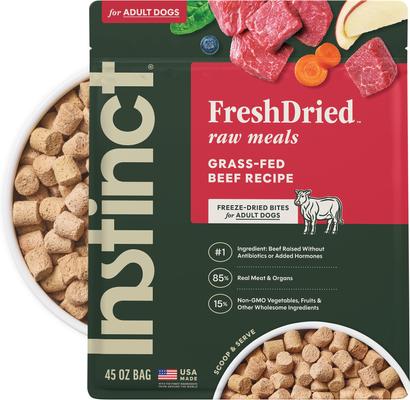
Instinct Raw Boost Dry Dog Food
Rating: 4.6/5 | $98.07 / 20lb bag | Amazon’s Choice
Nestlé Purina’s Instinct line occupies the sweet spot between conventional kibble and raw feeding. Raw Boost combines cage-free chicken kibble with freeze-dried raw pieces in every bag — giving dogs the texture variety and palatability of raw without the storage and handling requirements. No corn, wheat, soy, or potato. Supports lean muscle and healthy energy with cage-free poultry as the #1 ingredient.
What sets it apart: The freeze-dried raw inclusion in Instinct Raw Boost is not cosmetic. These are actual raw pieces — not flavor sprinkles or palatants — that retain more of the original nutritional profile than conventionally cooked kibble. For owners who want to introduce raw nutrition incrementally, or who want the marketing angle of “raw included” without full raw feeding commitment, this formula delivers the concept genuinely rather than as a gimmick.
The trade-off: The freeze-dried raw pieces are added post-cooking, which means they bypass some of the digestive processing that kibble undergoes. This is actually beneficial from a nutrient-availability standpoint, but it means the raw pieces pass through faster — a dog on Instinct Raw Boost may produce smaller, firmer stools on the raw-inclusion portion of the meal while digesting the kibble portion normally. This is not a problem, just different.
Cage-Free Poultry
No Corn/Wheat/Soy/Potato
$98.07 / 20lb bag | ~$115/month for a 50lb active dog
7. Merrick Backcountry Grain-Free — Best Grain-Free High Protein
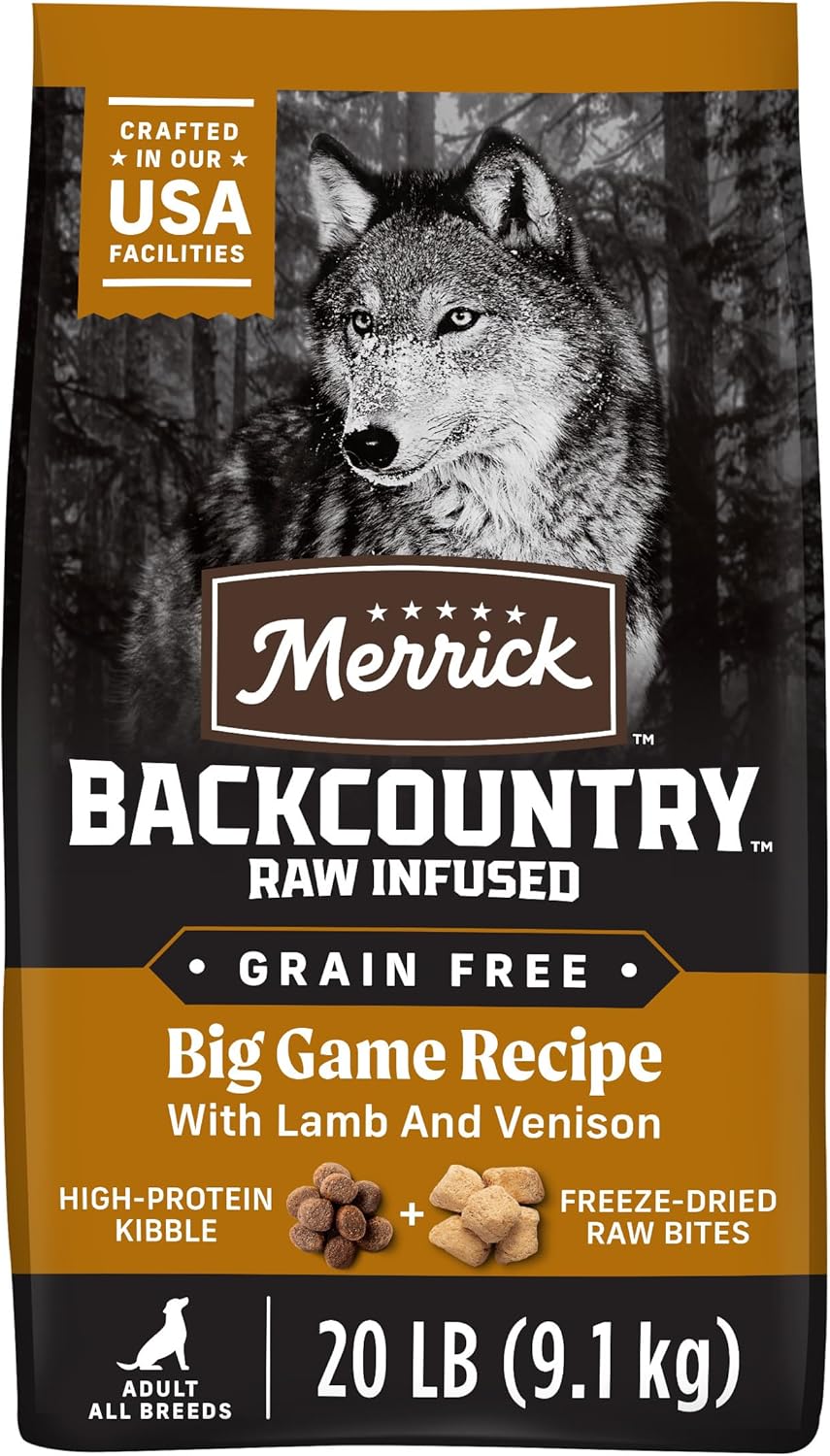
Merrick Backcountry Grain-Free Big Game Recipe
Rating: 4.6/5 | $38.99 / 20lb bag | Amazon’s Choice
Now owned by Purina but manufactured under Merrick’s original standards, Backcountry Grain-Free uses deboned venison as the #1 ingredient with freeze-dried raw pieces mixed into the kibble. Delivers 38% protein from a named novel protein source — venison — making it an excellent option for dogs with chicken or beef sensitivities, or owners who want grain-free without relying on legumes as the primary carbohydrate base.
What sets it apart: Venison is one of the leanest red meats used in commercial dog food, and Merrick uses it as a genuine primary protein rather than a marketing hook. At 38% crude protein and zero chicken or beef, this is the most targeted option in this guide for dogs with poultry or beef sensitivities. The freeze-dried raw inclusion adds palatability and nutrient density that most grain-free formulas at this price point cannot match.
The trade-off: Merrick Backcountry is grain-free, and the DCM caveat applies: while the FDA closed its investigation without establishing causation, veterinary cardiologists continue to recommend caution for breeds predisposed to dilated cardiomyopathy (Dobermans, Great Danes, Golden Retrievers, Boxers). For healthy dogs without breed-specific cardiac risk, this remains a solid grain-free option at a reasonable price.
Freeze-Dried Raw
Poultry-Free
Grain-Free (DCM caveat)
$38.99 / 20lb bag | ~$75/month for a 50lb active dog
8. Farmina Natural & Delicious Lamb — Best Italian-Made Grain-Free

Farmina Natural & Delicious Pumpkin Grain-Free Lamb & Blueberry
Rating: 4.6/5 | $116.42 / 26.4lb bag | Amazon’s Choice + Best Seller
Farmina N&D is manufactured in Italy under European Union feed safety standards, which are among the strictest in the world. The lamb-and-blueberry formula delivers moderate protein (26%) from a single named animal source with pumpkin for soluble fiber and digestive regularity. The lower protein percentage relative to others in this guide reflects Farmina’s philosophy of prioritizing digestibility and ingredient quality over raw protein numbers.
What sets it apart: Farmina’s primary differentiation is regulatory: EU pet food manufacturing standards require more rigorous ingredient sourcing documentation, safety testing, and traceability than US standards. For owners who prioritize ingredient transparency and manufacturing oversight, Farmina’s Italian production represents a meaningful upgrade over most US-manufactured alternatives. The lamb-and-pumpkin combination is also among the best-tolerated formulas for dogs with sensitive stomachs.
The trade-off: At 26% crude protein, Farmina N&D is the lowest-protein formula in this guide. For highly active or working dogs, this protein level may be insufficient without portion increases. For dogs with moderate activity levels, indoor dogs, or dogs transitioning from lower-quality foods, this is more than adequate — the digestibility and ingredient quality more than compensate for the lower percentage on paper.
Pumpkin for Digestion
Single Protein Source
Moderate Protein (26%)
$116.42 / 26.4lb bag | ~$120/month for a 50lb moderately active dog
How to Read a High Protein Label Correctly
Most buyers look at the crude protein percentage and stop. Here is what they are missing:
- Dry Matter Basis (DMB): The label percentage is “as fed.” To compare formulas accurately, subtract the moisture content (typically 10-12% in dry kibble) and recalculate. A 30% protein food at 10% moisture is actually ~33% protein on a dry matter basis. Always compare DMB when evaluating across brands.
- Ingredient Order vs. Protein Percentage: Ingredients are listed by weight before cooking. A whole muscle meat that is 70% water will appear higher on the ingredient list than a meat meal that is 10% water, even if the meat meal delivers more protein per gram. Named meat meals (chicken meal, fish meal) are often more protein-dense as ingredients than whole meats.
- Guaranteed vs. Typical Analysis: The label guarantees a *minimum* protein, not a typical amount. Most premium brands deliver 2-5% more protein than their minimum guarantee. Review sites that publish actual tested values (like Consumer Reports or the DFH database) are more reliable than label claims.
- Protein Quality (PDCAAS): The Protein Digestibility Corrected Amino Acid Score measures how well a protein supports human nutritional needs. For dogs, the concept translates similarly: animal proteins score higher than plant proteins. If the ingredient list shows pea protein, soy, or corn gluten meal in the top three positions, the protein quality is lower than a formula that lists only animal proteins.
High Protein and Kidney Health: What the Science Says
One of the most persistent myths in canine nutrition is that high protein diets damage healthy kidneys. This claim has been repeatedly examined and consistently debunked in peer-reviewed research — yet it continues to influence owner decisions and, unfortunately, some veterinarians who have not updated their knowledge since veterinary school.
The National Research Council (NRC) and AAFCO both state that there is no evidence that high protein intake causes kidney damage in healthy dogs. The kidneys filter nitrogenous waste from protein metabolism — if protein intake increases, the kidneys work slightly harder to filter it. This increased workload is well within the functional reserve of healthy kidneys. A dog with healthy kidney function does not have a measurable risk from high protein intake.
Where the science is genuinely nuanced: for dogs with pre-existing kidney disease (CKD), protein restriction is clinically indicated to reduce the nitrogenous load on compromised kidneys. For senior dogs (8+ years), many veterinarians recommend monitoring kidney values (BUN, creatinine) via annual bloodwork before assuming high protein is appropriate. The recommendation is not “avoid protein as you age” — it is “verify kidney function before increasing protein for a senior dog.”
For dogs with pre-existing kidney disease: Do not switch to a high-protein formula without veterinary guidance. Renal diets are specifically formulated with reduced protein at controlled phosphorus levels. Work with your veterinarian to select an appropriate diet for your dog’s specific stage of kidney disease.
Breed-Specific Protein Recommendations
| Breed Category | Recommended Protein Range | Recommended Formula | Notes |
|---|---|---|---|
| Working & Sporting (German Shepherd, Malinois, Border Collie, Lab) | 30-38% | Bully Max, VICTOR, Eukanuba, Annamaet | High caloric density critical for sustained output |
| Large/Giant Breed Puppies ( Dane, Mastiff, Rottweiler) | 26-30% (controlled calcium/phosphorus) | Farmina N&D, Eukanuba Large Breed Puppy | Excessive protein + rapid growth = joint stress |
| Small/Medium Active Breeds (Beagle, Cocker Spaniel, Whippet) | 28-32% | Instinct Raw Boost, Merrick Backcountry | Moderate protein; watch caloric intake closely |
| DCM-Prone Breeds (Doberman, Great Dane, Boxer, Golden) | 25-30% (grain-inclusive preferred) | Orijen Amazing Grains, Eukanuba, VICTOR | Consult cardiologist; avoid high-legume grain-free |
| Indoor/Moderate Activity (most companion breeds) | 22-28% | Farmina N&D, Orijen Amazing Grains | Higher protein is unnecessary; focus on digestibility |
| Senior Dogs (8+ years, healthy) | 25-30% (verify kidney values first) | Orijen Amazing Grains, Farmina N&D | Annual bloodwork recommended before increasing protein |
Frequently Asked Questions
Does high protein cause kidney failure in healthy dogs?
No — not in healthy dogs with normal kidney function. Multiple peer-reviewed studies (Brennan et al., 2006; Davenport et al., 2013) have found no link between high protein intake and kidney disease progression in healthy canines. The persistent myth originates from early rat studies that do not translate to canine physiology. The exception is dogs with diagnosed kidney disease, for whom protein restriction is clinically indicated under veterinary supervision.
Is 30% protein high for a dog?
For an adult dog, 30% crude protein is moderately high — above the AAFCO adult maintenance minimum of 18% but well within the range of premium performance formulas. For comparison: grocery-store brands typically range from 21-26%, premium brands from 26-32%, and extreme performance or raw-inclusive formulas from 32-42%. Whether a given percentage is “high” for your specific dog depends on their activity level and metabolic needs.
Can puppies eat high protein dog food?
Puppies need high protein — 28-35% for most breeds — but large and giant breed puppies require carefully controlled calcium and phosphorus ratios alongside the protein. For Labradors, Golden Retrievers, and smaller breeds, a standard high-protein all-life-stages formula is appropriate. For Great Danes, Mastiffs, and other large/giant breeds, select a large-breed-specific puppy formula. The key variable is not protein alone but the calcium-to-phosphorus ratio and total mineral content relative to growth rate.
Which protein source is best for dogs with sensitive stomachs?
For dogs with documented digestive sensitivities, novel proteins — proteins the dog has not been exposed to before — are typically the most digestible because they generate fewer immune responses. Venison, lamb, and fish are the most commonly recommended novel proteins for sensitive-stomach cases. Pumpkin (a soluble fiber) and added probiotics also support digestive regularity. Farmina N&D Lamb & Blueberry and Merrick Backcountry Venison are both well-suited for this application.
How do I transition my dog to a high protein formula?
Over 7-10 days, mixing the new food with the old in increasing proportions: 25% new / 75% old (days 1-2), 50/50 (days 3-4), 75% new / 25% old (days 5-7), then 100% new (days 8-10). For dogs with sensitive digestive systems, extend the transition to 14 days. High-protein formulas are more calorically dense than standard kibble, so monitor weight weekly during the transition — you may need to adjust portion sizes.
Bottom Line
High protein dog food is not a trend — it is a recognition that dogs are facultative carnivores whose ancestors consumed protein-dense diets. The science supports higher protein intake for active dogs, working breeds, and growing puppies, provided the protein comes from quality animal sources and the overall formula is properly balanced.
For most owners: Bully Max 30/20 delivers the best combination of protein density, caloric energy, ingredient quality, and cost-per-month of any formula in this guide. For owners who prefer grain-inclusive or are managing DCM risk: Orijen Amazing Grains or VICTOR Hi-Pro Plus are the top alternatives.
The most important step: regardless of which formula you choose, establish a baseline of annual bloodwork for your dog — particularly after age 7 — so that you have reference values to inform any dietary changes. Nutrition without data is guesswork. Data without context is just numbers.
This article was last updated April 2026. All prices, availability, and formulations are subject to change. Verify current listings before purchasing. This information is for educational purposes and does not substitute for professional veterinary advice.

About James Miller
Dog owner from Shanghai. Every article on FurryFriendTips is based on personal research — reading labels, tracking FDA recalls, consulting veterinary professionals, and testing food with my Maltese, Snowy. No sponsorships, no brand deals. Read my full story →
🐾 First-hand experience · Vet fact-checked · Updated weekly